Read and Weep: the Sad Tale of Halper and the Fbi
Receive $50 off an eligible $100 purchase at the Outside Shop, where you'll notice a selection of make-proper noun products curated by our gear editors, when you sign up for Outside+ today.
Neil Darish was upward on the roof shoveling a heavy snow off his McCarthy Club when he saw the 2 well-worn pickups coming down the road. It was a frigid January afternoon in 2002, a time of year when fifty-fifty a single unfamiliar vehicle is a strange sight in McCarthy; almost nobody visits in wintertime, when the 60-mile dirt road to town becomes a continuous, treacherous sheet of ice and the sun rises above the Wrangell Mountains for only a few hours each day.
Only there they were: two trucks, drifting slowly up the road. Every bit the vehicles drew closer, Darish noticed people riding in the open beds, huddled against the 20-below-zero air. 'Who the hell rides in the back of a pickup in the expressionless of the Alaskan winter?' he thought as the trucks pulled to a end in front of the society and ane of the hunched figures, a young man, sprang out.
"Papa! Papa!" Darish heard him shout. "This is what we thought Fairbanks was gonna be like!"
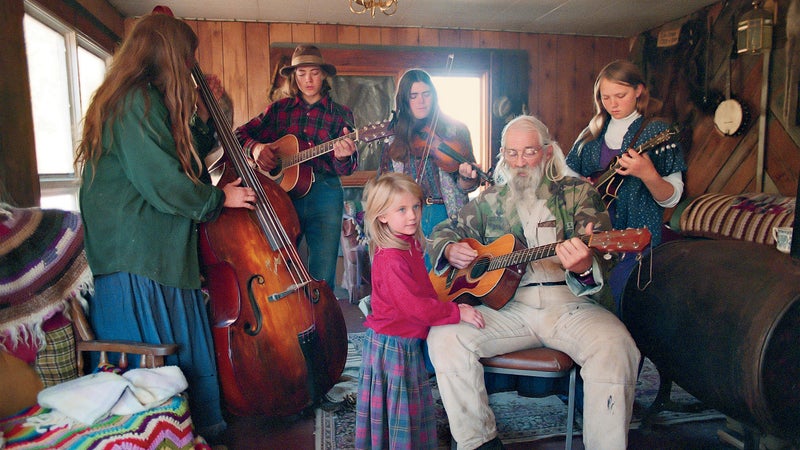
The others poured out later on him: ten or so young men and women, ranging from their teens to tardily twenties, all clad in rough flannel shirts or flowing homespun dresses, many wearing buckskin holsters conveying Bibles.
They called the one driving the beginning truck Papa. He was older, simply his weathered brow fabricated information technology difficult to tell exactly how old; he seemed tired and globe-weary, and had piercing blue eyes, a long white beard, and long white hair spilling from beneath a wide-brimmed lid. When Darish climbed down from the roof to invite the strangers into his society's dining room, the man introduced himself as Pilgrim. He said that he and his children had come to McCarthy looking for a new home.
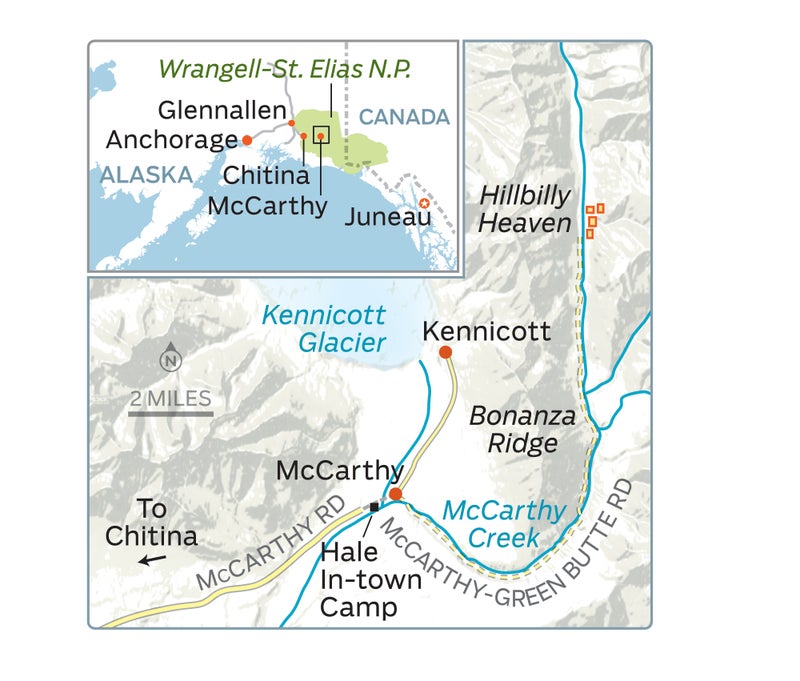
The potential addition of and then many new residents was large news for a town of 50 that doesn't ofttimes get big news. A seven-hour drive due east from Anchorage, McCarthy lies smack in the middle of America'south largest wilderness expanse, 13-million-acre Wrangell St. Elias National Park. Information technology's the kind of place where the homeschool curriculum still includes trapping and tanning, and where opinions on a subject like religion are shaped by the kind of gratitude toward a creator that i feels later recently miraculously escaping from the jaws of a grizzly comport. At the beginning of the 20th century, the expanse was domicile to virtually a grand people and one of the largest copper operations in the world, the McCarthy-Kennecott mine. But after the mine's Low-era closure, the town languished until 1980, when the cosmos of Wrangell St. Elias transformed McCarthy into a pocket-size tourist destination. Today it's about as far abroad from civilization every bit i can become by road in Northward America.
"Everyone was always so in dear with what they thought nosotros represented," said Joshua Hale, "they never bothered to notice out about all the horrible things actually going on."
Papa Pilgrim explained that, afterward a few decades of living off the land and by the Lord in New United mexican states'due south Sangre de Cristo Mountains, his family had come to Alaska to copy their pious frontier life. They'd lived in Fairbanks and Homer, he said, simply to detect both too overrun with the sins and vices of ordinary America. But remote and empty McCarthy—at present, this was the spot they'd been looking for. Why, they liked it so much that Pilgrim's wife, Country Rose, and the rest of their children would certainly bring together them.
Every bit a gesture of goodwill, Pilgrim sent his children back out to the trucks for their instruments—fiddles, guitars, a mandolin—and soon the sounds of an impromptu bluegrass concert filled the mountain air. Darish made a few phone calls, and nearly a dozen McCarthyites showed up on snowmobiles to meet the new arrivals. The whole display was a trivial odd, but those kids sure could play.
Most of the residents in attendance that night were taken with the beautiful family, their musical talents, and their reverent, godly manner. No one seemed to notice that the kids didn't make center contact with strangers or that they spoke simply when their father asked them to. No one had any inkling that Papa Pilgrim wasn't exactly who he said he was or that he was even remotely capable of the heinous deeds his family would afterward charge him of. Almost no one, that is.
"Information technology was a fun night," remembers Darish, "but my partner Doug well, he idea all along, from that very beginning nighttime, that Papa Pilgrim seemed similar an obvious con homo."
Alaska has always been a famous terminal redoubt for seekers, dreamers, hustlers, and ne'er-exercise-wells, and the man who appeared in McCarthy as Pilgrim certainly deserved his place amidst them. Built-in Robert Allan Hale to an affluent and well-connected Fort Worth, Texas, family unit in 1941, he arrived in Alaska trailing a lifelong reputation as a mystical and adaptable Svengali who had followed an improbable bout through American political and glory culture. His baroque rap sail of declared misdeeds included the murder of his first wife, the daughter of former Texas governor John Connally; a conspiracy to bribery President John F. Kennedy; and the rumored abduction of a woman he held convict on a New United mexican states ranch belonging to the actor Jack Nicholson.
It was places like McCarthy—places where the rules of the civilized world gave way to the freedoms of wilderness—that Unhurt had e'er sought. He'd frequented San Francisco'southward Haight-Ashbury district in the late sixties and had run in the same Los Angeles circles as Charles Manson and his Family; he'd taught transcendental meditation on an Oregon commune and had embarked on a vision quest in Southward America. He thrived wherever people were seeking answers and willing to listen to the ones he offered. Friends, neighbors, and family recall Hale equally a master manipulator, possessed of a mesmerizing charisma.
"Bob could've done anything with my life if he wanted to," says Priscilla Wilbourn, who followed Hale'south meditation teachings in the early seventies and clearly remains transfixed by his charm. "I swear, one time I did see him levitate!"
Given this history, information technology'southward hard to believe that Unhurt didn't know exactly what he was doing that first night in McCarthy when he paraded his children into Darish's lodge: He wanted the gathered residents to trust him, to assume that his huge family's effect on the tiny community would be beneficial. It had worked. By the stop of the evening, Darish and his neighbors had politely encouraged Hale to buy belongings in the area.
Each night, the patriarch had taken a bath prepared for him by his children, who were allowed to bathe every third or quaternary night, in their male parent's dirty water.
A few months later, he did just that, returning to McCarthy with Country Rose and their 15 children, aged from just a few months to nearly 30, with biblical names like Jerusalem, Psalms, Lamb, and Hosanna. They bought an old mine xiv miles outside of boondocks, up the abandoned McCarthy Green Butte Route, and christened it Hillbilly Heaven. The sale toll for 420 acres and a few weather-worn cabins was $450,000, and Hale made a $30,000 downwards payment with greenbacks obtained from the Alaska Permanent Fund. (The fund pays dividends to all Alaska residents with proceeds from the Trans-Alaska Pipeline; some years, it amounts to more than than $2,000 per person, children included.) Because the McCarthy Green Butte Road was impassable by truck, Hale bundled for horses and bush-league pilots to shuttle in his family unit and evangelize supplies.
At first, the abundance of Alaska welcomed the Hales. They had xx years' do subsistence living in New Mexico, simply here they had fish and game to supplement their chickens, sheep, and goats. The middle children helped State Rose care for the youngest, while the older sons and daughters attended to chores: chopping wood, tending the garden, maintaining pieces of machinery—tractors, a bulldozer that had come with the holding. To earn cash to help pay the mortgage, the eldest sons Joseph, 25, Joshua, 22, and David, 20, began offer McCarthy's summertime tourists guided horseback rides up to their property. The Hales besides donated their time and energy to community projects, helping rebuild a church shed that had burned in a small fire and constructing a tourist-information kiosk.
In the autumn of 2002, when the family ran curt on money to pay for delivering supplies, Unhurt used the bulldozer to clear the quondam road to town. The route crossed through Wrangell St. Elias National Park, and when rangers discovered Unhurt'due south work the following jump, after the snowmelt, they began surveying damage in preparation for a lawsuit. Rumors began swirling in the Alaska press that the Hales were armed and unpredictable and that things might get the manner of Ruby Ridge. And then Hale invited a television crew from an Anchorage station, to let Alaskans run across the family's God-fearing lifestyle for themselves.
What the cameras, and the newspaper reporters that followed them, establish at Hillbilly Heaven was a time capsule from America'south romanticized frontier days. The TV segment, which aired in June 2003, opened with a panning shot of the Wrangell Mountains as Hale'southward vocalisation, sweet and loftier, intoned the chorus of a traditional bluegrass song: "In dreams of yesterday I wandered back to my little motel door…" The homestead had a phone and a generator, just modern civilities concluded at that place. The family never watched television or listened to the radio, and they read merely two books: the Holy Bible and John Bunyan's 1678 Christian allegory, The Pilgrim's Progress. When the children bathed in the washtub, they did so with their undergarments on, for, as Hale boasted, none of his children had ever seen a naked human body. Not even their own.
Hale came across as wise and serene, speaking in a gentle, afar vocalization, while Joseph and Joshua inspected Park Service survey stakes. Hale told reporters that none of his children had ever left dwelling to marry. His eldest girl, Elishaba, 28, explained why. "Nowadays, everybody's trying everybody else on similar a new pair of blue jeans," she said. "And that's not the way we do it. My favorite thing in life is to work and serve my brothers and sisters. I don't know how I could be any happier. I ain't looking for anything else."
Soon, the story of the backwoods "Pilgrims" spread to national and international outlets—The Washington Post, The Economist, the BBC, and CNN. And while reporters uncovered mysterious details about Hale's past, the patriarch seemed to revel in the attention. In the fall of 2003, a group in McCarthy organized a "Berlin airlift": Volunteer bush pilots flew in supplies donated past concerned citizens from across the nation.
"Information technology's just cute," Unhurt remarked to one AP reporter, describing the airlift. "[People have] poured out their hearts."
McCarthy-Dark-green Butte Route leaves McCarthy at Neil Darish'southward lodge, traveling through an evergreen woods earlier breaking into a immigration and descending to the gravelly banks of McCarthy Creek. From at that place, you have a view up the valley to the imposing 6,000-foot peaks that line the valley's sides: Green Butte and Porphyry Mountain and Bonanza. Hillbilly Heaven lies about 12 miles farther up the route a twenty-four hour period's hike, more than than an hour past horseback, or, if you lot're riding a snowmobile, as I was during the wintertime of 2006, almost forty minutes.
Visiting Hillbilly Heaven was something I'd planned on always since 2003, when, during a trip to Alaska, I'd heard about the Hales on the local radio and found myself taken in by the story of their simple life. I'd begun obsessively following the local news coverage of their standoff with the Park Service, and when I got home to New York, I purchased a re-create of their bluegrass album, Put My Name Down, from a website created by land-use advocates. On another site hosted by the family'southward supporters in McCarthy, I scrolled through photos of their pioneer existence dinner at the homestead, band practice, even a ladies' bighorn-sheep-hunting circuit.
Over the next ii years, equally the fight with the Park Service began crawling through state and eventually federal courts, I twice postponed visits to Hillbilly Heaven. And past the fourth dimension I did make it, the popular Swiss Family unit Robinson image of the Hales had been revealed as a charade. In Oct 2005, Alaska state troopers arrested Robert Hale on 30 counts of physical and sexual assault, coercion, and incest.
Unhurt's abort left me wondering how his children—seemingly brainwashed their unabridged lives—had managed to break their begetter's spell. That fall, I fabricated the first of five visits to Alaska to slice together what had really gone on at Hillbilly Sky. Over three years, I tracked down individuals who knew Unhurt at before stages of his life: relatives and in-laws from Texas, fellow hippies from the Oregon commune, neighbors from the family unit's time in New United mexican states. At first, Hale's wife and children refused to talk to the media, a stand that softened as the example worked its fashion through the courts. I would eventually meet and become familiar with the Hales, especially Joseph, the eldest son, who offered to serve as the family's spokesman at their father's sentencing hearing in Anchorage in 2007. At that hearing, I explained to Joshua Hale how I'd initially been captivated by his family'southward seemingly idyllic life.
"That'due south what everyone says," he responded. "Everyone was always and so in love with what they thought we represented—the wilderness family, the communion with nature—that they never bothered to find out about all the horrible things really going on."
When I made that January 2006 trip to Hillbilly Heaven, Country Rose and the children were living near Anchorage with another large Christian family, merely John Adams, a longtime McCarthy resident and friend of the Hales, offered to show me their vacant homestead. We'd be joined by Kurt Stenehjem, an Anchorage real estate banker who'd crashed his Cessna during the 2003 airlift and concluded upwardly spending viii days as a guest of the Hales.
We set out from Adams's house by snowmobile in most-full black, speeding through McCarthy and onto McCarthy-Green Butte Road. The road closely follows the form of the creek, and we crossed the frozen h2o xiii times, stopping at a few points forth the way. After several hours, we arrived at a modest rise set back from the banks, where there was a cluster of wooden structures: Hillbilly Sky. It was around noon, but the sun was barely higher than the surrounding peaks; the long wintertime in those cramped cabins must've been nearly unbearable sub-zero temperatures, nearly no direct low-cal, miles and miles of waist-deep snow to the nearest neighbor in one direction, hundreds of square miles of forbidding rock and water ice in the other.
Every bit nosotros parked our machines, Stenehjem described his stay with Unhurt and the family unit. Each night, the patriarch had taken a bath prepared for him by his children, who hauled h2o to fill the tub and chopped wood to stoke the burn. The children were allowed to breast-stroke every third or fourth night, in their begetter's dirty h2o. At mealtime, Hale was always served first by the sturdy and headstrong Elishaba and was the only one to eat fresh vegetables. Because of the standoff with the Park Service, the mood at Hillbilly Heaven had been tense. One evening, Hale gathered the family unit in prayer. "Lord," he said, "if they come up at us with guns, we pray that they would have a bullet for each one of usa."
But what struck him nigh was the command Hale had over his children. "Pilgrim didn't want me to take my reckoner screen facing into the room for fright that they would go enraptured," he said as we approached the main cabin. "He told them to ignore me, no centre contact."
Elishaba and Jerusalem hid in the woods for 2 days, wrapping themselves in sleeping bags while their male parent patrolled the trails.
On the eighth dark of Stenehjem's stay, Hale got a gleam in his eyes. He wanted his children to play music and dance about. He told his visitor stories about his wild days in San Francisco. "Papa allow his hair downward. I could run across the old hippie," recalled Stenehjem. The next morning, Unhurt demanded that Stenehjem leave. "He seemed threatened, every bit if I'd seen a part of him he didn't want me to." As Stenehjem waited for one of the airlift planes to retrieve him, he asked Hale why the sudden change of middle. "Yous and I accept seen a lot in this globe," Hale responded curtly, "merely my children oasis't. They're pure. I don't want them violated or corrupted."
Once we'd fabricated our mode dorsum to town, I found that many McCarthyites who had strongly supported the family were reevaluating their impressions. "All those bumps and bruises? I just figured that they were a office of the family unit's hardy frontier life," said Neil Darish. "I experience similar an idiot for not noticing sooner."
Rick and Bonnie Kenyon, co-pastors of the McCarthy-Kennicott Community Chuch, had at beginning been close with the Hale children, who would occasionally stop by the Kenyons' log motel for tea without their father'due south supervision. But in the fall of 2004, Kenyon found himself in a disagreement with Hale over some of the family's business concern practices. "It was typical for him to avoid arguments by just leaving," Kenyon told me, "simply that time, he raised his phonation and became irrational before storming off. When next we saw the younger children, they averted their eyes. The older children would call us evil to our faces." At ane betoken, Joseph told Kenyon to rot in hell, though he later apologized.
"Bob had convinced the kids that God doesn't love everyone," said Kenyon, "and he was God'due south mouthpiece on who deserved love."
To his wife and children, Hale was a trigger-happy and unpredictable monster, a tyrant who delighted in sadistic manifestations of his ain power. And while the remoteness of the family'southward homesteads in New United mexican states and Alaska gave his perverse inclinations room to fester, there were signs all forth that something was wrong with him.
Hale's own father was I.B. Hale, a larger-than-life figure who, later a prolific college-football career, turned down an offer to play for the Washington Redskins and later on joined the FBI. In the early 1940s he moved to Fort Worth, Texas, where he raised his twin sons, Robert and William, and became a fixture on the local country-social club scene. I.B. Hale was a dominating man, and his sons grew up with something to evidence. From his earliest years, Robert was known for his explosive temper, his capable fists, and his willingness to slug it out with anyone. "The but manner to win a fight against Bobby," William told a college acquaintance, "was to grab a heavy object and hit him until he blacked out. If you didn't knock him out quickly, information technology was best to run."
At 17, Hale ran away with his high school sweetheart, 16-year-sometime Kathleen Connally, the girl of local attorney John Connally, who would afterward get governor of Texas and ride with John F. Kennedy through Dallas the twenty-four hours the president was shot. (The governor suffered serious injuries in the shooting.) The couple eloped to Tallahassee, Florida, where Connally found out that she was pregnant. Soon, they began fighting. On the night of Monday, April 27, 1959, one statement became so heated that Connally spent the night with their flat building'southward landlady. The following morning, she went to the local police station, where, according to Palmer Newton, who was on the Tallahassee constabulary force at the fourth dimension, she asked to be sent home to Texas. But before the officers could do anything, she returned to the flat. She was found dead there a few hours later, the back of her head diddled off by a 20-guess shotgun.
To this day, it's not clear what happened. The morning time subsequently Connally's death, Hale told a coroner's jury that he'd come home to discover his wife lying on the sofa with a loaded shotgun, threatening to kill herself. He'd pleaded with her to put the gun downwards, but she refused, and when he lunged for the weapon it went off. The death was somewhen ruled an accident, despite conflicting evidence including the fact that, according to Newton, the gun was absent any of Connally's fingerprints.
Later Connally's decease, Hale went home to Fort Worth, where he got his GED and attended Texas Christian Academy for a short time. He so made his mode to Los Angeles, where he was spotted by the FBI breaking into the apartment of one of President Kennedy'south mistresses, Judith Campbell Exner. No one has ever confirmed exactly what Hale was doing in Exner'southward flat, just, as reported by Seymour Hersh in his 1997 book The Night Side of Camelot, there's reason to suspect bribery: Around that same fourth dimension, the federal regime awarded I.B. Unhurt's new employer, Full general Dynamics, one of the largest military contract in U.S. history. (In an angry letter he sent to me earlier this year, Unhurt issued a rambling denial of both the break-in and whatsoever wrongdoing in Kathleen Connally's death. He's given similar blanket denials to reporters investigating many aspects of his life presented here.)
Later on Fifty.A. came Houston, where Hale worked as a gigolo for society ladies, and and so Lake Tahoe, where he spent a winter as a ski bum and served three months in jail for marijuana possession. By the mid-sixties he'd wandered dorsum to California, where he went by the name Bob Sunstar and traveled in the same circles every bit Charles Manson. By the end of the decade, he'd had four children in Texas, Oregon, and California by three dissimilar women.
It was while resting near a waterfall in the San Bernardino Mountains that Hale met 16-yr-one-time Kurina Rose Bresler, who would go Country Rose. Bresler was the runaway girl of Hollywood actress Betty Freeman; according to Freeman, Hale, and so 33, spirited her girl away. "He trapped her with sex and drugs," she would tell an Anchorage Daily News reporter in 2003.
Bresler and Unhurt had their firstborn, Butterfly Sunstar now Elishaba in 1975. And approximately every two years for the next thirty, Bresler would conduct Hale some other kid, all far from medical care. For more than than two decades, the family unit raised sheep and goats and grew vegetables on a small parcel of a northern New Mexico ranch owned by Jack Nicholson, an arrangement worked out by Freeman with the histrion's business manager.
Around the time Elishaba turned 18, he started forcing her to satisfy his sexual desires.
Throughout his wanderings, Hale had dabbled with New Age tracts such equally The Aquarian Gospel of Jesus the Christ, but it wasn't until 1979, while living on Nicholson'southward ranch, that he converted his family to his dwelling-brewed Christianity. He took the name Preacher Bob and then Pilgrim and, over time, became skilful at spreading his version of the Lord's word. In the early nineties, he convinced his twin brother, William, a successful Fort Worth veterinarian, to give up his material possessions and come to New Mexico. William's wife, Patsy, remembers coming habitation from work before he left to discover that her wear was missing. "Bob convinced Billy that my wardrobe was the work of the devil," she says. "He said they burned it."
The New Mexico ranch was so remote, and Hale's rules almost leaving then strict, that Country Rose and the children would sometimes go six months without interacting with anyone outside the family unit. Absent anything resembling normal social mores, strange things happened: The older sons would later recount an episode in which several of them, confused teenagers forced to share a unmarried bed, experimented sexually with one another. Hale's commandments were to exist followed at all times, and when someone disobeyed, he would administer a "correction." Such punishments could be unbelievably barbaric. When Hale found out well-nigh his sons' deviance, he lashed them over a whipping barrel. Country Rose, 17 years Hale's inferior and securely afraid of him, suffered terribly. Once, after Hale dragged her exterior by her pilus to administer a chirapsia, he nailed clumps of her hair to a post as a warning. Around the time Elishaba turned 18, he started forcing her to satisfy his sexual desires.
Every bit the years went on, neighbors began edifice homes closer and closer to the ranch and started taking a concerned interest in the backwoods family unit, peculiarly afterwards police-enforcement officers came looking for a woman Hale had allegedly brainwashed and convinced to run away from her husband, along with their daughter. In the late 1990s, the neighbors notified Hale that they were drafting a letter to Nicholson asking that the family be evicted from the ranch.
Alaska beckoned. It was there, Unhurt imagined, that he would create a holy, untainted community populated by him and his children. And from the outside, that was only what it seemed.
Ironically, Hale found it fifty-fifty more difficult to proceed his family secluded in the Last Borderland. In office, this was because the elements were so much harsher; he needed more assist from outsiders to keep his association warm, healthy, and fed. Only his biggest problem was money. In purchasing Hillbilly Heaven, Hale had saddled himself with substantial debt. So, beginning in 2003, he immune Joseph, Joshua, David, and Moses to work for a hunting guide several hours north of McCarthy.
Free from their male parent's control, his oldest sons began violating his prohibition confronting attending church building with other families. At one service, they met Jim Buckingham, a born-again former U.S. Regular army officer from Palmer, Alaska, who introduced them to his nine children. Friendships quickly developed, and in the summertime of 2004 the Hale family went to Palmer to meet the Buckinghams. The gathering, in full general, was positive. But during a subsequently, smaller gathering, Buckingham noticed bruises on Elishaba and grew suspicious. He confronted Hale about them, simply Unhurt denied that anything was going on. Buckingham then began speaking openly, in front end of Joseph and Joshua, about the right human relationship betwixt a father and his children, and not long after, Hale forbade his family from talking with the Buckinghams again, claiming they weren't truly saved.
"That was always the way it worked," Joseph told me. "Only when we'd outset getting close to some other family, my dad would find something wrong with their doctrine and forestall us from seeing them again."
Meanwhile, McCarthy was slowly falling out of love with the Hales. At the outset of the 2004 summertime tourist season, Unhurt stationed some of his youngest children at a popular footbridge, where, dressed in ragged outfits, they sold tickets for a shuttle betwixt McCarthy and the Kennecott mine, a service already provided by other surface area families. Before long, there was growing sentiment that the Hales were everywhere stealing business organization, grazing their horses next to the airport's gravel runway. Worst of all, the family had prepare a squatter'due south camp down the street from the McCarthy Lodge to sell their tourist services, and their livestock and detritus were spilling out into the public correct of way.
By September, the boondocks was fed up. On a Saturday afternoon, Stevens Harper, a park ranger whose driveway had been partially blocked by the family's operation, arrived with a bulldozer to remove the army camp, and two dozen residents gathered to support him. Hale backed down, and after that fall, he acquired a bundle at the end of the McCarthy Road, well-nigh John Adams's firm. He erected a few small structures, merely the army camp lacked plumbing, electricity, and a phone, so the family frequently turned to Adams to borrow tools or make a telephone call to Hillbilly Sky.
Winter's short daylight hours came to McCarthy, making one hazy twenty-four hour period bleed into the next. Things were placidity until the morning of January 10, 2005, when Joseph and Joshua showed up at Adams's door looking concerned. They said that their begetter was non feeling well and that they were going to head out to Hillbilly Heaven.
Later they left, Adams walked over to the shed to see if everything was all right. It was silent every bit he approached, and when he knocked on the door, Hale invited him in. The drab, unfurnished space was dimly lit and cluttered with supplies. Elishaba was standing in one corner with her arms crossed. Hale was in the other, leaning on his cane, glowering. Adams asked if everything was all correct; both muttered yep. Adams was suspicious, but didn't feel information technology was his place to arbitrate, so he returned dwelling.
Elishaba would later on describe that what was happening was a "correction" brought almost by her questioning if it was correct for Hale to accept sexual relations with his own girl in an Anchorage court: "You punched me with those trained fists," she said, addressing Hale. "Yous nailed and wired the door shut so I could not leave… If I cried out, yous would tear me to pieces, those were your words."
Later on 2 days of astringent concrete and sexual abuse, Hale escorted Elishaba back to Hillbilly Heaven, where he made her vesture a ski mask to hibernate her wounds. Past at present, Jim Buckingham's example had begun to sink in among Elishaba's older brothers. When Elishaba showed them her bruises, they confronted Unhurt in front of the family unit, enervating that he admit to his sinful behavior, repent, and vow never to touch their sister again. Hale went berserk. He punched Joshua in the face up, breaking his nose and knocking him out cold.
Not long after, Joseph, Joshua, and three of their younger brothers slipped away in the dark, escaping to the town of Glennallen, where they took shelter with the Hoffmans, a family unit they'd met while guiding. Elishaba and the others remained trapped partially by fear, but mostly by a conviction that betraying their male parent would toll them their souls.
Unhurt became even more tearing after his sons left, and Elishaba feared that he might soon take her life. So on a frosty forenoon in late March 2005, afterward Hale left the homestead early with 2 of his youngest sons to assemble supplies in town, she decided to make her break.
As presently every bit Hale departed, she hurriedly gathered food, sleeping bags, and 2 white sheets—one for her and one for Jerusalem, at 16 Hale'southward second-oldest daughter—that the sisters could use to cover-up themselves in the snow. Elishaba talked with Joseph by phone, and the two made a jerky programme to run into in McCarthy, where they could and then all return to Glennallen. But getting to McCarthy meant that Elishaba and Jerusalem would accept to make it down the McCarthy Green Butte Route earlier their father began his return. They would take a few hours, just there was no way of knowing exactly how many. And once in town, they would take to hide until their brothers arrived.
Elishaba and Jerusalem said goodbye to Country Rose and their remaining brothers and sisters, then loaded a snowmobile. But when they turned the ignition, nothing happened—Hale had removed the spark plug. Jerusalem ran to the toolshed and scrounged up a spare, and after a little banging around inside the engine housing, they made it nigh a half-mile down the road to a snowy meadow. And then the engine belt snapped. Jerusalem plodded back up the trail with the spark plug to fetch some other machine, while Elishaba hunched over the engine, desperately trying to repair the chugalug with bailing wire and a pair of pliers.
"It was similar a dream where you run for your life and nil's working," she afterward told reporter Tom Kizzia, of the Anchorage Daily News, in the only interview she'south given on her escape. "Where you endeavor to run and can't run."
Elishaba knew her father could exist starting up the road any minute, and even if she gave up and returned to the homestead, he'd observe the snowmobile in the meadow and realize she'd tried to get away. There was no turning dorsum. Finally, afterward a few disturbing minutes, Jerusalem returned on a second snowmobile, and the sisters set off again for McCarthy.
Meanwhile, in town, Hale and John Adams had spent the morning loading sleds. When they finished, Unhurt hitched a sled to his snowmobile and set up out for the homestead with his ii sons riding forth. Adams, who agreed to shuttle out another load, told Hale that he had an errand to run but would catch upwardly. Some 20 minutes later, when Adams fabricated the turn onto McCarthy Green Butte Road, he was surprised to see 2 female riders speed past him in the opposite management.
Adams caught up with Hale at the edge of the homestead, where he was debating with his sons near whether whatever snowmobiles were missing. Hale seemed agitated and soon mounted his own snowmobile and headed back to McCarthy lonely. Adams followed a few minutes after.
"I could tell that something had gotten to him," recalls Adams. "He'due south usually careful on a snowmobile, but equally I followed his tracks, I could run across that he was going every bit fast as he could." A few times, Hale's form veered off the trail. Footprints revealed that on several occasions, Unhurt had marshaled the forcefulness to push his 500-pound car out of deep snow.
When Adams arrived back in McCarthy, Hale was at his in-town camp. Unhurt mentioned something virtually Elishaba and Jerusalem going missing, and Adams realized the women he'd seen must have been the sisters. He'd after acquire that they had pulled off the road, into the wood between Hillbilly Heaven and McCarthy, where they'd waited, concealed, until Unhurt passed.
Still, the escape program was falling apart. By the time Joseph and Joshua made it to McCarthy, Unhurt was in that location, likewise. There'd been some confusion on the phone almost the hastily bundled meeting identify, and the girls, not trusting anyone to provide shelter, decided to hide in the wood exterior town. Joseph and Joshua knew their sisters were somewhere nearby, but none of the children wanted some other violent confrontation with their begetter, so the brothers returned to Glennallen to await word from them. Elishaba and Jerusalem remained in the woods for ii days, wrapping themselves in the sleeping bags and white sheets while their father patrolled nearby roads and trails.
On the third day, in one case the sound of their father'south snowmobile engine had stopped reverberating through the woods, the girls went to Adams'due south house and called their brothers in Glennallen; Joseph and Joshua picked them up that night. 6 months later, after much coaching by Jim Buckingham and a few more acts of violence inflicted by Unhurt on the younger children, the siblings went to the police.
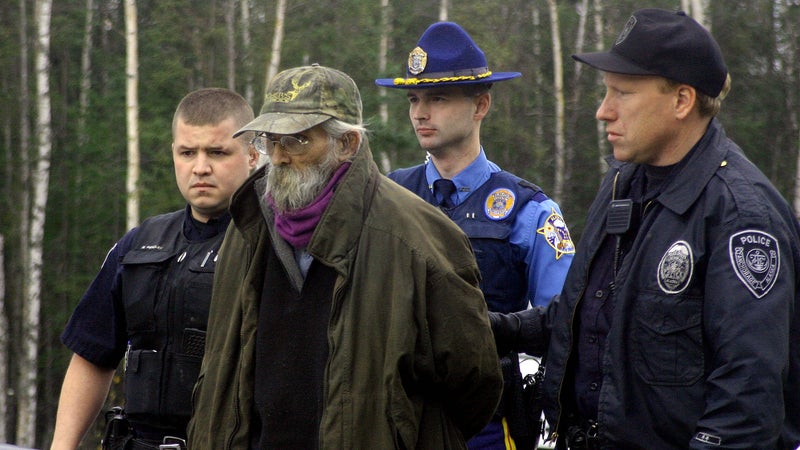
Unhurt was arrested exterior Anchorage on October half-dozen. The next day, when the arraigning estimate asked Hale to land his profession, he said simply, "I am a father."
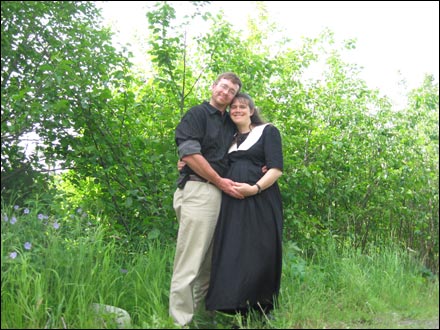
Joseph Unhurt, now 31, lives exterior Palmer, Alaska, with his married woman, Lolly, Jim Buckingham's second-eldest daughter, and their two young sons. Their mail-and-axle home lies high upwards on Lazy Mountain and looks out over a rolling pasture that tumbles downward to the Matanuska River, a braided glacial outflow that unfurls along a route that travels a hundred miles to Glennallen and further nonetheless to McCarthy.
Like his other siblings, Joseph doesn't go back to McCarthy much; the family homestead has been sold, and the children's lives are firmly planted in the Palmer area, where the wilderness is a bit closer to the rest of the world. His mother and younger brothers and sisters alive not far off, with the Buckinghams. Joshua and his wife, Sharia, besides a Buckingham daughter, and Elishaba and her husband, Matthew Speckels, are just up the road.
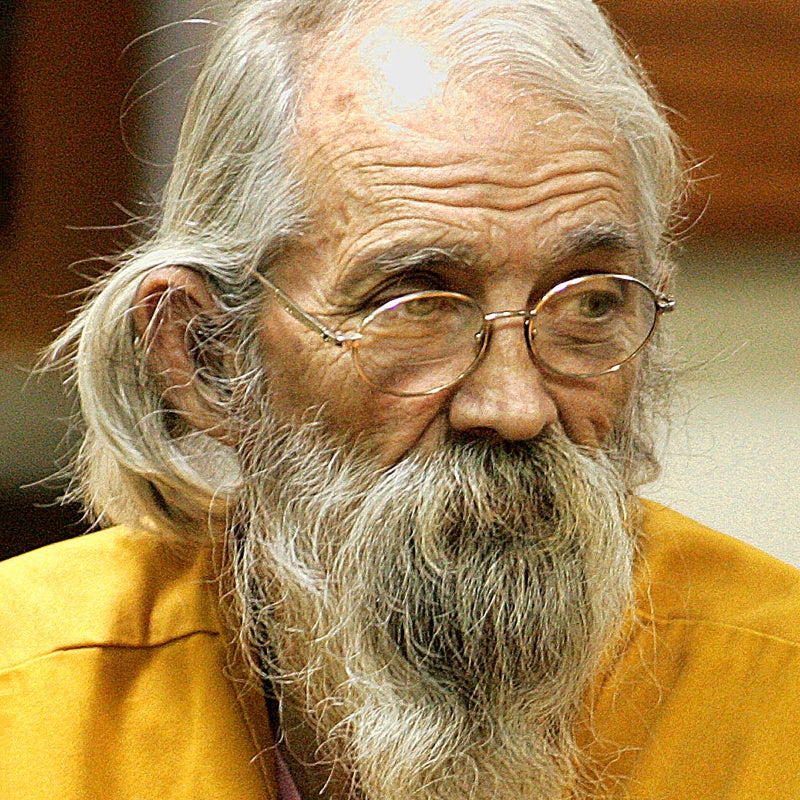
In November 2007, I sat in an Anchorage courtroom for Unhurt'southward sentencing hearing, watching as Land Rose and the children catalogued his abuse and deceit. For the developed children, there was self-recrimination every bit well born of a painful frustration that they had not intervened earlier. "I desire to enquire forgiveness that I ever let the things go on that went on in our house," Joshua cried from the witness stand. "I don't know what possessed me, in all my life, to bargain with it and let it happen. I crush my chest and weep that this family unit undertook… There is so much to undo, at that place is and then much that can't be undone." The entire Hale family sobbed along with him.
The family continues to embrace a virtuous and simple life. They go to a local church and pay their bills by working in the trades they learned while living off the grid: structure, carpentry, caring for livestock. They read the Bible and back up one another in their various projects. Only the children face up a long recovery and many indelible challenges. They were all poorly schooled. Joshua, Joseph, and Elishaba share a stiff sense of having had half their lives stolen from them. And they all take a lingering wariness about the outside world.
One chilly mean solar day this past March, I drove out from Anchorage to have dinner with Joseph and Lolly. When I arrived, Joseph welcomed me with a beaming grin and the shake of a manus nearly twice as thick as my own. "C'monday in," he said. Remembering Alaskan custom in mud flavor, I pulled off my shoes at the door.
Lolly had fabricated a pot roast with carrots and potatoes, and we saturday in their sparse kitchen and talked equally we ate. All of the Hales remain very religious, and so most of the conversation concerned my own salvation: Had I felt Jesus in my life? Did I have a girlfriend? If so, when would I ally? When Joseph spoke almost his ain upbringing, he did and then through a haze of incertitude and cliffhanger as if he was nonetheless sorting out which parts had really happened. "I'll never be able to understand why my father did the things he did," he said. Both Joseph and Lolly were incredibly gracious, responding to my inquiries long after I could sense they were ready for bed.
"The strangest thing about information technology," Lee Ann Kreig, a close friend of the family, told me later, "is that for all the evil in Bob, his kids certainly came out all right."
Hale was sentenced to xiv years in prison, and in May he died of complications from diabetes. Soon later on, I emailed Joseph to express my condolences.
"It has been both sorry and liberating," he responded. "Only more liberating. God has been adept to us."
Source: https://www.outsideonline.com/adventure-travel/destinations/north-america/papa-pilgrims-progress-dark-tale-alaskan-frontiersman/

Post a Comment for "Read and Weep: the Sad Tale of Halper and the Fbi"